Before the age of 18, everyday transportation meant a personal car; after the age of 18, transportation meant my own two feet or a subway. In Cambodia, I get around primarily on a moto dop (motorbike taxi) or a tuk-tuk (a passenger carriage attached to a motorbike, pictured below). If you want to take a look at how these forms of transport look on the road together, take a look at this post from last year.
A little background: There are no set prices or meters for moto dop or tuk-tuk fares, so bargaining is a part of everyday life here. Tuk-tuks cost approximately double a moto dop, though, and are more "touristy" by nature. As a helpless passenger, your experience on either of these forms of transport depends largely on the personality and kindness of your driver, especially if you are a foreigner. Though locals use tuk-tuks for large numbers of people or to carry things, they are largely tourist transportation. Tourists are the main source of income for tuk-tuk drivers, who have been known to charge $10 to a foreigner for a trip that would cost a local $1 and a foreigner who knows better $1.50. For a positive, interesting description of the new trend in making your tuk-tuk look unique ("pimping out" your tuk-tuk), visit this blog. The carriage is typically red, but I've seen a baby pink one, a camouflage one, and several with colorful lights or music inside.
This leads me to the point of this post - tuk-tuks: friend or foe? Tuk-tuk drivers wait outside of areas they know tourists will be, like Western hotels, restaurants, and bars. When I leave my house every morning, a herd of tuk-tuk drivers shout, snap, clap and wave to get my attention. They call out, "Lady, you want tuk-tuk?" "Tuk-tuk, OK?" Some become particularly aggressive. Once I saw a tuk-tuk driver call out to a heavyset woman as she left her hotel, "Tuk-tuk, OK?" She politely declined with a smile. He persisted: "Where you go?" "I like to walk," she said, still pleasantly. He looked at her, following her as she walked up the street, then said, "Yeah, you need to walk." The smile left her face. I've heard stories of tuk-tuk drivers who confused patronage as true love and others who become physical when they feel that the fare wasn't sufficient. Now, this is not to say that all tuk-tuk drivers are rude young men like these. Some are honestly trying to make an income for their family, and never having personally felt the pressure of poverty, I can't criticize someone's attempts to feed his family (tuk-tuk drivers are always male). If being aggressive means dinner for the night and not being aggressive means leaving your family hungry, I think we would all make the same choice.
I'm not proud of it, but somehow, I tend to not be as nice to tuk-tuk drivers as I should be. Perhaps it's the language barrier, perhaps it's the frustration at the inherent tension between foreigner and local, but somehow when last night's tuk-tuk driver asked for more money, I just rolled my eyes and walked away, mumbling something about him being "ridiculous." Would I ever do this with a US taxi driver? Here, I've gotten out of tuk-tuks because I didn't like the way the driver was acting (docking his pay) and I've yelled out commands in snobby tones. I'm not exactly Meryl Streep's character from the Devil Wears Prada, but certainly there is room for me to a bit more compassionate. Plus, there's no other option...
Showing posts with label khmer culture. Show all posts
Thursday, December 8, 2011
Saturday, December 3, 2011
Afternoon commute
They're even on the right side of the road. If you look at the bottom right, you can see me with my camera in the rear view mirror below my research assistant's motorbike helmet.
Wednesday, November 30, 2011
Back at it
I'm more than two months into my second trip to Cambodia, and I keep meaning to post to my blog again - so here goes! Some factoids about my current life (both boring and silly):
1. I'm two-thirds finished with my last of two research sites. This one is located 30 km southwest of a town called Battambang. Battambang is located around 300 km northwest (towards Thailand) from Phnom Penh, the capital where I spent the first half of the project. The commute to my current research site involves a ride on a motorbike past picturesque rice paddies and a beautiful temple built on a craggy rock, not to mention the wind in my hair. (Don't worry, Ma, I wear a helmet and I'm not driving!) The research itself involves discussion groups with adolescent girls; in the picture above, tenth grade girls are discussing ways to improve the school environment for girls if they were given a million dollars.
2. The research site includes a vocational training center, whose name translates to "Forest for Baby Tigers Vocational Training Center." At the entrance gate, there are two roaring tiger statues. Some days it takes everything in me not to pose for a picture doing my best Tony the Tiger roar.
3. I spent last Saturday night hunting and killing a baby cockroach that appeared behind my hotel bed. After forcing it from behind the headboard with a folder, I committed animal-cide with an air conditioner remote. I turned away for a few minutes, then looked back at my kill. It was moving, despite being completely flat. Don't worry, I crushed his squirmy little body into pieces.
Sunday, September 26, 2010
Saturday, September 25, 2010
Friday, September 24, 2010
transport, sisowath quay
Thursday, August 26, 2010
fried frog with lemongrass stuffing: C+
Something I definitely need to do more of here is to try the street food! In between surveys today, we stopped at a roadside stand because the fried frogs caught my coworkers' attention. Above, Cha'riya, a member of the survey team, displays her street food. Below is the full stall. You can see pig's ears, fried frogs with lemongrass stuffing on skewers, assorted fish and pickled things. I tried the frogs, and they weren't bad, but the stuffing was definitely the highlight. Earlier that day, I did get what looked and tasted like small waffles from a street vendor - all they needed was some blueberries or strawberries and I would've been in heaven! And three small waffles only cost about 12 cents. I think the frogs cost a bit more, something like a whole quarter!
Wednesday, August 25, 2010
bai: kind of a big deal
Worldwide, rice is the most important crop for human consumption. It seems as though calling rice ("bai" in Khmer) the staple food here in Cambodia is an understatement. As in many countries where it has been cultivated for centuries, rice has invaded the culture and the language here. The word for kitchen literally translates to "rice house;" breakfast, lunch and dinner are morning, noon and night rice. More than half of Cambodians are farmers; almost all of them grow primarily rice. Rice is grown by flooding the plot during planting, and below are some photos of harvesting. It's a muddy job, requiring strong arms for pulling the plant and a knife to chop off the stalks, which I believe are used to feed livestock during the hot season. As the workers pulled up the rice plants, flying insects crowded the air in search of new swampy homes.
The point of the last picture is just that woman's smile, and the mesh tank top her baby is wearing - not just for 80s pop singers anymore! She's definitely a rice farmer though, so it's kind of related.
Friday, August 20, 2010
women's work
The photo above is taken from "Women and Work in the Garment Industry," 2006, available here.According to the World Bank, the garment industry is the main export industry here in Cambodia, representing more than 80% of total exports in 2006. The workers are mostly women from the rural areas, more than 330,000 of them, who send most of their $60-$70/month to their extended families in the provinces. The document "Women and Work in the Garment Industry," published by the World Bank, discusses findings from a study on the situation of garment workers in 2006. Garment work affects health and nutrition, breastfeeding and childcare, personal safety, and creates an environment where sexual harassment is accepted. In order to make more money, many women will work overtime, meaning that they must leave the factory in the evening to walk back to the dormitory, where the women stay because they are away from their families. The study included focus groups of women workers, 9.3% of whom had a close personal friend who had been raped in the previous year. As one woman recounts:
"One worker was raped by 3 men after she left the factory at 8:30pm. She was killed. When this problem occurred, we complained to police, but we have to spend money. Sometimes they release the doer because doer has much money. The factory took no responsibility. One more thing is that we dare not complain because we are shy/feel embarrassed." (Women & Work in the Garment Industry, p. 15)
The document also discusses how such gang rapes are usually committed against sex workers, implying that garment workers are considered low in social standing. Existing labor laws don't seem to be effective or enforced in the garment factories, for example, labor laws state that factories should provide space and one hour of paid breastfeeding time per day, yet only 30% have a nursing room.
Especially after the recent financial crisis, the Cambodian garment industry, as everywhere, has felt pressure to keep prices down, described in the Phnom Penh Post on Wednesday. Unfortunately, there is very little motivation for factory owners, mostly Chinese and Korean businessmen, to enact policies to protect these women on their own. In the Huffington Post yesterday, Jonathan Tasini (Democratic candidate for a US Senate seat from New York) reflected on the growing dissatisfaction with poor treatment of low-paid workers globally. It's clearly a complicated issue, without a clear single solution. However, as Tasini ends his article:
Where this leads is not easy to tell. It is easy to talk about worldwide solidarity - and a whole lot harder to make it happen, because of cultural and language differences, the massive physical distances between one slave-wage haven and another, the inability of the poorest to have enough resources to organize on a daily basis...a whole host of reasons.
But, it is clear-the people have had it. They cannot, and should not, put up with the siphoning of the world's wealth and resources into the hands of a few.
Thursday, August 19, 2010
more field notes
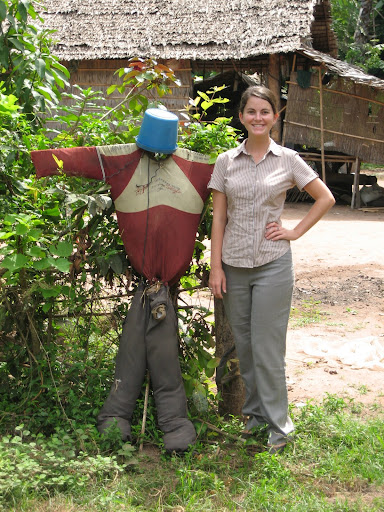
While waiting for the surveys to be conducted on Wednesday, the other American intern and I walked around the village in Kampong Chhnang province, in central Cambodia. Pictured, taken with my co-intern's camera: (1) big-footed chicken; (2) how one mother gets two babies to sleep simultaneously, so that she can weave palm baskets in the third hammock; (3) buckethead.
Saturday, August 14, 2010
getting out of the office
For the past couple of weeks, I have been designing a set of surveys to be given to the participants in the combined rural agriculture and nutrition program run by the NGO I am with. There are five survey tools: a focus group with women farmers, an interview with village health volunteers who are in charge of nutrition education, an interview with the model farmer in the community, an interview with a community council member, and an interview with half of the women who participate in the focus groups. Even though yesterday was just the field test, and the actual data collection will take a week, it still felt pretty cool to see the participants actually responding to the questions and providing the information that we're looking for. (I know I'm lame!) The interviews and focus groups were conducted simultaneously in Khmer with pen and paper, so I just wandered around and observed. Pictured below: (1) focus group; (2) interview with village health volunteer; (3) a warm cat nap (just for fun!).

Monday, July 26, 2010
more than thirty years later: verdict
An earlier post contains some media links to info about the first of the Khmer Rouge trials, that of Comrade Duch, responsible for more than 14,000 deaths at the Toul Sleng Prison. This prison is now a genocide museum in the middle of Phnom Penh. The verdict was announced today: only 19 years in prison (shortened from 35 because of 11 years already served and 5 years held illegally by the Military Tribunal). That adds up to less than 12 hours in jail per death. There has been a flurry of coverage in the international media and its the front page of all of the local news sources. Here's the NY Times Blog coverage with photos here, and some background info here from CNN, and a great NY Times article with quotes from his statements here. Check out the Phnom Penh Post website for several articles.
island biking
Yesterday, a couple friends and I went on a bike tour called "Islands of the Mekong," described on the tour company's website as follows:
On the map below, Phnom Penh is in the middle lowest portion, and the river on the right is the Mekong, which is more than 2700 miles long from the Tibetan Plateau in China to Vietnam.
I didn't want to risk taking my nice camera biking, so I settled for some lower quality photos. The picutre below was taken near the beginning of the bike tour, with the Tonle Sap (the river on the left above) in the background. The floating house likely belongs to Vietnamese fishermen, and the dragon that I'm awkwardly leaning on is part of a Chinese temple. The steps lead into the river, an unknown number covered by the water.
We took a ferry across to the islands, and biked right into a raucous group of young people going door to door to raise money to pay for a new pagoda. They wore brightly colored costumes, like the giants below and a Chinese dragon, and banged on a loud drum and cymbals. My friends below contributed - check out our stylish helmets!

Women on these islands weave beautiful silks, which are sold in the markets in Phnom Penh for around $70/each, according to our guide. It takes them about a week to make one. Garment workers in the city, on the other hand, make a similar amount of money in a month. The video below shows two women working at looms side by side on the bottom level of a traditional wooden house.

This picture is taken in a garden with statues of the symbols of the Chinese years, like Year of the Rat, Year of the Tiger, etc. I'm technically a cow, but this donkey (I think?) was more fun to imitate.
Cross the river by boat and take in this relaxing 30km ride through Cham Muslim communities on quiet back roads to reach the Mekong Islands. On the islands, cycle through orchards and market gardens. Enjoy the peaceful farmland and learn about the lives of the people who live here.
On the map below, Phnom Penh is in the middle lowest portion, and the river on the right is the Mekong, which is more than 2700 miles long from the Tibetan Plateau in China to Vietnam.
I didn't want to risk taking my nice camera biking, so I settled for some lower quality photos. The picutre below was taken near the beginning of the bike tour, with the Tonle Sap (the river on the left above) in the background. The floating house likely belongs to Vietnamese fishermen, and the dragon that I'm awkwardly leaning on is part of a Chinese temple. The steps lead into the river, an unknown number covered by the water.

Women on these islands weave beautiful silks, which are sold in the markets in Phnom Penh for around $70/each, according to our guide. It takes them about a week to make one. Garment workers in the city, on the other hand, make a similar amount of money in a month. The video below shows two women working at looms side by side on the bottom level of a traditional wooden house.In the second picture below, our guide, Mean (pronounced me-ann), is picking the leaves of the rambutan plant, whose tea he says will help him sleep well.

This picture is taken in a garden with statues of the symbols of the Chinese years, like Year of the Rat, Year of the Tiger, etc. I'm technically a cow, but this donkey (I think?) was more fun to imitate.This temple was all gilt. The buddhas below were smiling; their counterparts on the other side of the stairwell were frowning. Inside the temple, the walls were painted with Buddhist scenes. If you look closely, the panel in the middle row on the far right is pretty graphic, and our guide said it is meant to remind us that "everyone dies." It's hard to see, but I hope we don't all have our entrails pecked out by a bird though, like this poor guy!
Saturday, July 3, 2010
un, deux, trois
My language skills are slowly getting better, thanks to my extremely kind and patient tutor Sokan. I'm not about to discuss Buddhist philosophy in Khmer, but I can direct a tuk-tuk or mototaxi driver. How to count to ten in Khmer:
It translates to: "May your enemies run far away from you./ If you acquire riches, may they remain yours always./ Your beauty will be that of Apsara./ Wherever you may go, many will atend, serve and protect you, surrouding you on all sides." Don't worry, Ma, I'm not planning to get a tattoo in Bangkok!
1 - mouy (moo-ee)
2 - bpee
3 - buy
4 - boon
5 - pram
6 - pram mouy
7 - pram bpee
8 - pram buy
9 - pram boon
10 - dop
Not too difficult, right? Well it gets more complicated, but instead of getting into that, here is Angelina Jolie's tattoo of a Buddhist incantation written in Khmer in honor of her adopted son Maddox:
It translates to: "May your enemies run far away from you./ If you acquire riches, may they remain yours always./ Your beauty will be that of Apsara./ Wherever you may go, many will atend, serve and protect you, surrouding you on all sides." Don't worry, Ma, I'm not planning to get a tattoo in Bangkok!
Monday, June 28, 2010
Apsara dancing
Last weekend I went to a wedding reception, where all kinds of dancers performed, including amateur Apsara, traditional Cambodian dancers. "The Rough Guide to Cambodia" has this to say about Apsara dance:
No visit to Cambodia is complete without at least a quick glimpse of women performing the ancient art of apsara dance, as depicted on the walls of Angkor's temples. Donning glittering silk tunics, sequinned tops (into which they are sewn before each performance to achieve the requisite tight fit) and elaborate golden headdresses, they execute their movements with great deftness and deliberation, knees bent in plie, heels touching the floor first at each step, coy smiles on their faces. Every position has its own particular symbolism - a finger pointing to the sky, for instance, indicates "today", while standing sideways to the audience with the sole of the foot facing upwards represents flying.Below is a photo of the amateur Apsara dancers at the wedding reception, in what sounds like the flying position.
In the regin of Jayavarman VII there were over three thousand apsara dancers at court - the dances were performed exclusively for the king - and so prized was their skill that when Thais sacked Angkor in the fifteenth century, they took a troupe of dancers back home with them. Historically, the art form was taught only at the royal court, but so few exponents survived the ravages of the Khmer Rouge that the genre was very nearly extinguished. Subsequently, when Princess Boppha Devi - who had been a principal dancer with the royal troup - wished to revive it, she found it helpful to study temple panels to establish the movements. It was not until 1995, a full sixteen years after the fall of the Khmer Rouge, that Cambodians once again witnessed a public performance of apsara dance, at Angkor Wat.
Tuesday, June 22, 2010
more than thirty years later + media resources
I have to admit, I know very little about Cambodia's history. Until I met someone who worked there, I hadn't heard about the UN Assistance to the Khmer Rouge Trials (UNAKRT), which is bringing to trial a few surviving members of the regime that killed 1.7 million Cambodians, or 1/4 of the population, in the 1970s. The Khmer Rouge has come up twice in conversation in the short couple of weeks that I have been here: once, with a co-worker who explained that he was educated in a camp in Thailand because he "couldn't live in Cambodia" at the time, and again, with a farmer who was talking about his fields and motioned to a nearby Khmer Rouge burial ground.
Here is an article in the Phnom Penh Post about the first case that will receive a verdict, a man called Duch who was the director of the Tuol Sleng Prison and responsible for 16,000 deaths. I've seen articles that are hoping for a life sentence for him; he is hoping to be released. With internationally-supported tribunals like this, some say that the money (more than $50 million) would've been better spent for poverty alleviation efforts in Cambodia today, rather than seeking largely ineffective "justice" for unimaginable genocide decades after it occurred - after all, what single penalty can possibly make up for the death of 16,000 mothers and brothers? Since the fall of the regime, former Khmer Rouge members have been living in society, and two-thirds of Cambodians today were not even alive during the regime. This NPR segment talks about the feeling of ambivalence among some Cambodians towards the perpetrators. The following is a reporter's discussion of a woman's response to the question of how she feels about living in the same community as a former Khmer Rouge member:
Here's a summary of a documentary screened at the Human Rights Watch Film Festival in New York last Sunday, called "Enemies of the People," which includes interviews with former Khmer Rouge members. Here's a trailer, where you see Thet Sambath, the Cambodian co-director, talk in an almost eerily friendly way with Brother Number Two, Nuon Chea, to get information about what happened in the killing fields.
Perhaps as important as the trials, here is an article about the push to teach about the Khmer Rouge in schools.
Here is an article in the Phnom Penh Post about the first case that will receive a verdict, a man called Duch who was the director of the Tuol Sleng Prison and responsible for 16,000 deaths. I've seen articles that are hoping for a life sentence for him; he is hoping to be released. With internationally-supported tribunals like this, some say that the money (more than $50 million) would've been better spent for poverty alleviation efforts in Cambodia today, rather than seeking largely ineffective "justice" for unimaginable genocide decades after it occurred - after all, what single penalty can possibly make up for the death of 16,000 mothers and brothers? Since the fall of the regime, former Khmer Rouge members have been living in society, and two-thirds of Cambodians today were not even alive during the regime. This NPR segment talks about the feeling of ambivalence among some Cambodians towards the perpetrators. The following is a reporter's discussion of a woman's response to the question of how she feels about living in the same community as a former Khmer Rouge member:
Nobody here has a problem with him, she says. He's a good neighbor, he's gentle, and he comes to all the weddings and funerals and helps out around the village when needed. I'm not angry at him, she says, I'm angry at the Khmer Rouge who killed my husband and my two sons. But he is not that man.Here is some video coverage of Tuol Sleng and an interview on NPR.
Hod Troy says she's not paying much attention to the tribunal, either. I'm too busy, she says - and she's not alone. The day Duch's trial opened, I stopped at a small cafe just down the road from the trial venue. You could see the court from the cafe, but nobody was looking. All eyes were glued to two televisions on the back wall airing a Khmer soap opera.
Here's a summary of a documentary screened at the Human Rights Watch Film Festival in New York last Sunday, called "Enemies of the People," which includes interviews with former Khmer Rouge members. Here's a trailer, where you see Thet Sambath, the Cambodian co-director, talk in an almost eerily friendly way with Brother Number Two, Nuon Chea, to get information about what happened in the killing fields.
Perhaps as important as the trials, here is an article about the push to teach about the Khmer Rouge in schools.
Thursday, June 17, 2010
pursat food pictures
Photos: (1) a market lady in Pursat, whose stall smelled incredible, (2) hot peppers, (3) cutting jackfruit, (4) these sea urchin-looking fruit are called rambutan, and are pretty tasty, (5) desserts - the ones in focus are palm cakes, wrapped in banana leaves
Subscribe to:
Posts (Atom)